12 June, 2026
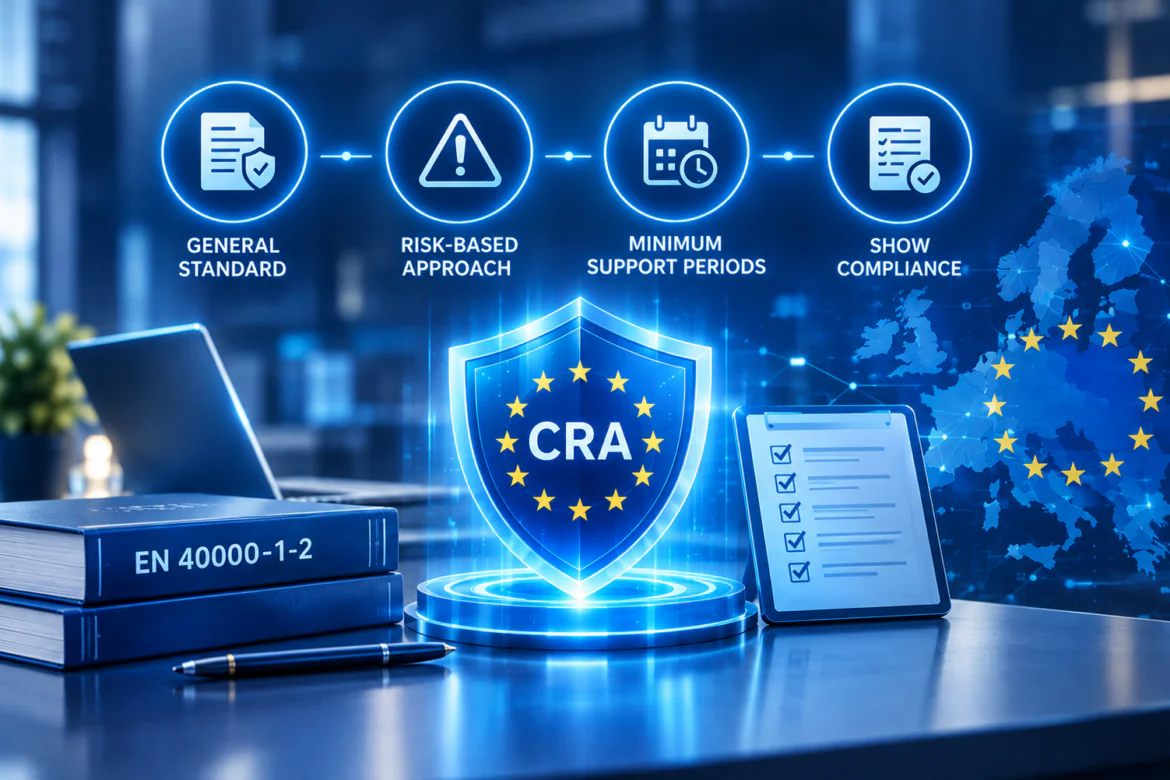
With the gradual rollout of the EU Cyber Resilience Act (CRA), cybersecurity is transitioning from a corporate “best practice” to a strict legal obligation. For any organization manufacturing or selling hardware and software with digital elements in the EU, a new paradigm has emerged: PRC (Product Risk and Compliance).
But what exactly is PRC, why does it matter for CRA compliance, and how can frameworks like OWASP SAMM and tools like Codific SAMMY turn this regulatory hurdle into a structured business advantage?
Defining PRC: Product Risk and Compliance
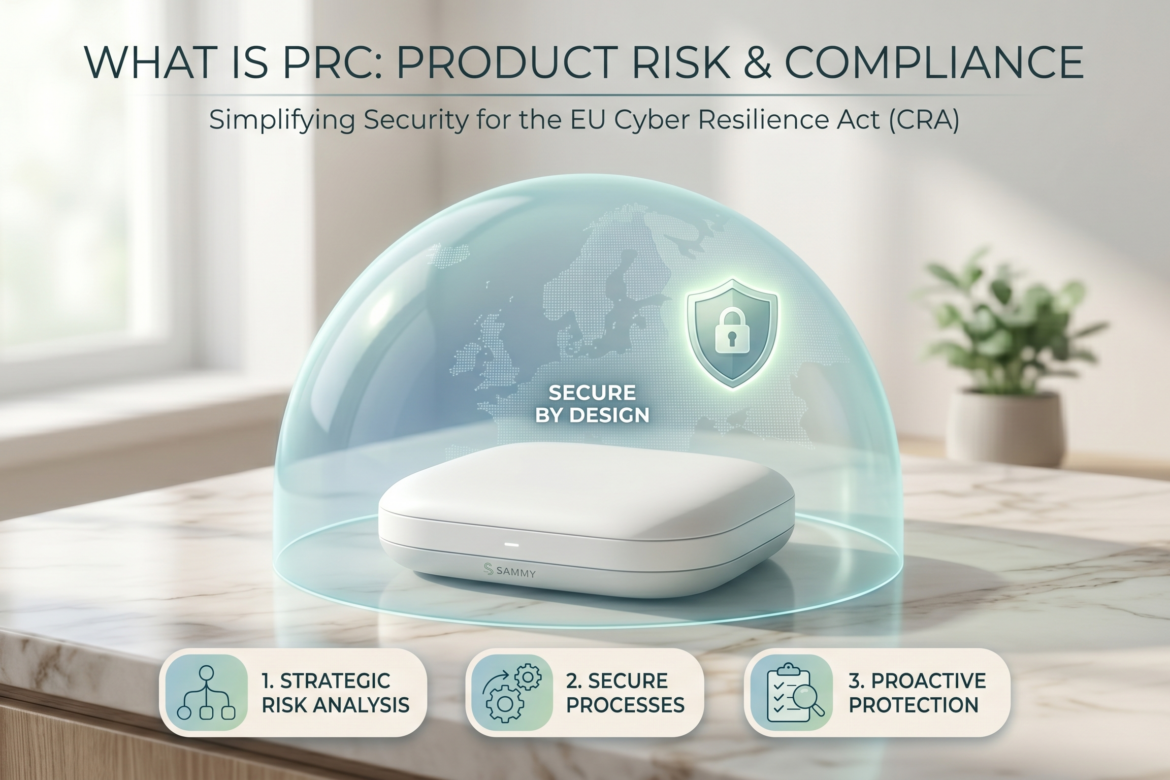
Product Risk and Compliance (PRC) is the systematic discipline of identifying, assessing, managing, and mitigating cybersecurity risks across a product’s entire lifecycle, while ensuring continuous alignment with legal and regulatory frameworks.
Unlike traditional enterprise compliance, which often focuses on internal corporate IT networks and policies, PRC zooms in specifically on the commercial products you build and ship. It bridges the gap between technical application security (AppSec) and legal market access. In short, if your product isn’t secure by design and compliant by default, you risk facing massive fines, product recalls, or being barred from the EU market entirely.
The Core Driver: Product Risk Management in the CRA
The Cyber Resilience Act fundamentally shifts responsibility to the manufacturer. Security can no longer be an afterthought or a patch applied right before launch. The CRA mandates an ex-post enforcement model backed by strict pre-market essential requirements: security must be embedded into the product from day one.
This is where Product Risk Management becomes the heartbeat of compliance. Under the CRA, manufacturers must:
- Conduct a comprehensive cybersecurity risk assessment before a product is placed on the market.
- Integrate these risk findings into the technical documentation of the product.
- Continually manage risks and address vulnerabilities over the product’s entire expected lifecycle (up to 5 years or the product’s lifetime).
Without a structured risk management process, proving compliance to regulators or conformity assessment bodies is virtually impossible.
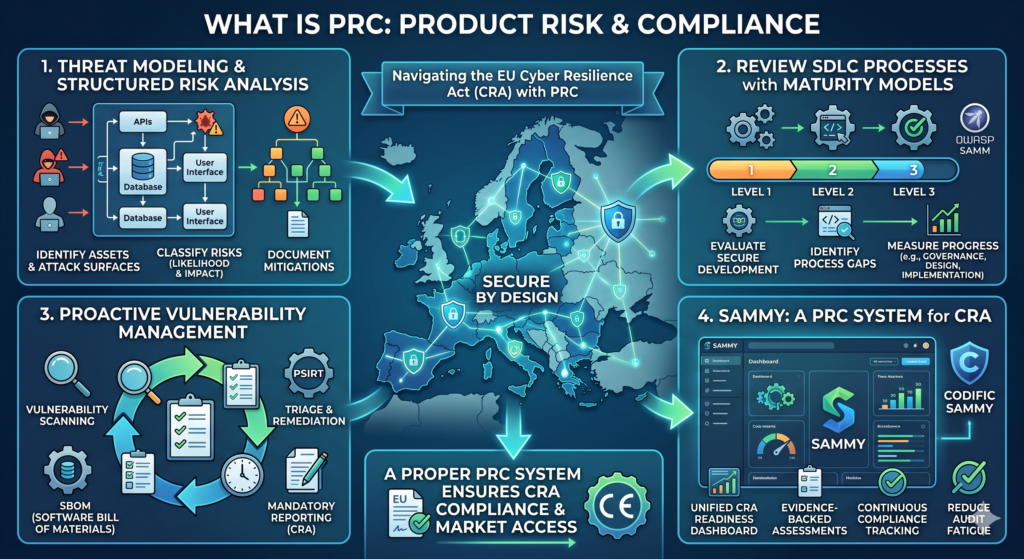
1. Structured Analysis and Risk Classification in Threat Modeling
You cannot manage a risk you haven’t identified. This makes Threat Modeling a foundational requirement for PRC.
To satisfy the CRA, threat modeling cannot just be an informal whiteboard session. It demands a structured analysis and a clear classification of risk. Organizations must look at their product architectures systematically to understand:
- Attack Surfaces: Where can an attacker entry point be established?
- Threat Vectors: What methods could they use?
- Data Flows: How is personal or critical operational data protected in transit and at rest?
By classifying risks based on impact and likelihood, software engineers can prioritize security requirements effectively. A robust PRC system documents these threat models, showing regulators that your design choices were deliberately engineered to mitigate specific, well-understood digital hazards.
2. Reviewing SDLC Processes with Maturity Models (OWASP SAMM)
Achieving compliance isn’t a one-time checklist; it requires shifting the organizational culture and process. The most effective way to evaluate whether your Secure Software Development Lifecycle (SDLC) can support CRA requirements is by using a maturity model.
The industry standard is the OWASP Software Assurance Maturity Model (SAMM). OWASP SAMM provides a balanced, measurable framework structured around five core business functions:
- Governance
- Design
- Implementation
- Verification
- Operations
Rather than aiming for a generic or unobtainable “perfect score,” SAMM promotes a risk-driven approach. By reviewing your current SDLC processes against SAMM’s 30 security practices, you can establish an honest baseline, identify process gaps, and plan pragmatic steps to mature your software security profile.
3. Proactive Vulnerability Management and Disclosure
A core pillar of the CRA is how an organization responds when things go wrong. Vulnerability management is no longer just about running occasional static analysis (SAST) tools; it is a high-stakes operational requirement.
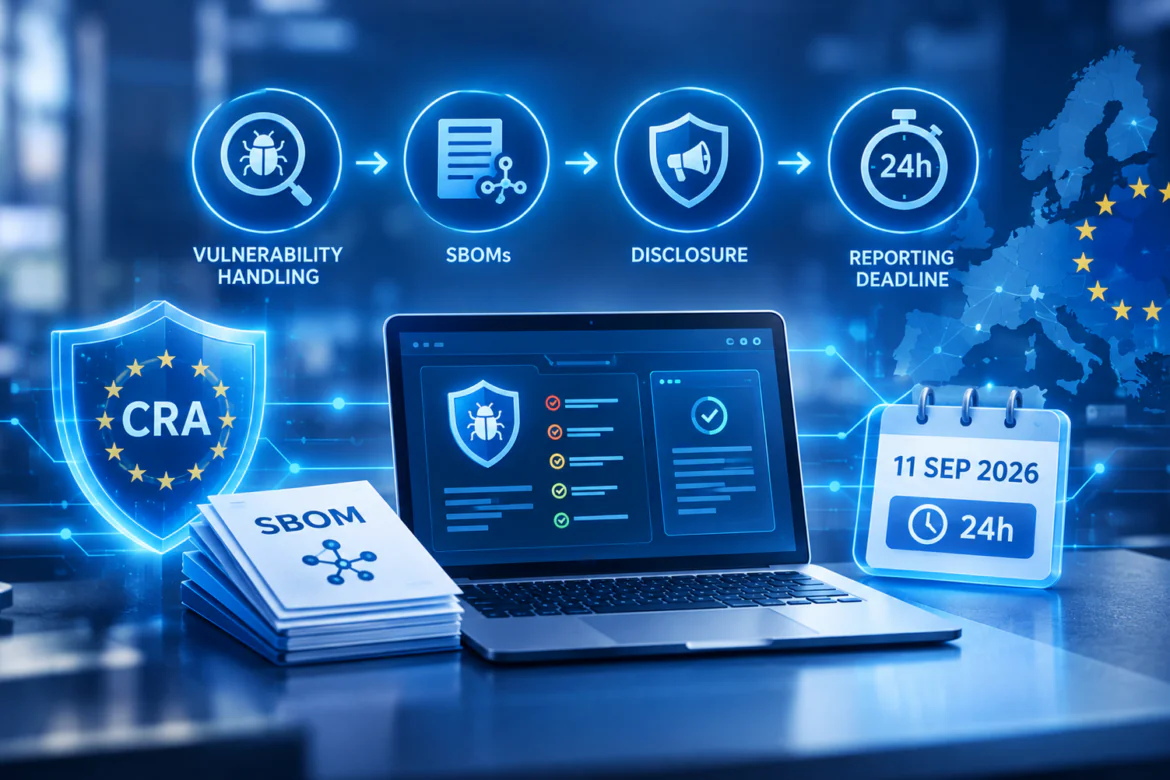
Under the CRA guidelines, manufacturers must maintain an accurate, machine-readable Software Bill of Materials (SBOM) to trace every dependency, library, and open-source component used in their product. When a vulnerability is discovered, it must be logged, triaged, and mitigated quickly.
Furthermore, the CRA introduces strict, time-sensitive mandatory reporting deadlines. Manufacturers must report actively exploited vulnerabilities to ENISA and national CSIRTs via the CRA Single Reporting Platform within tight windows (such as a 24-hour early warning and a 72-hour full notification). A structured PRC workflow ensures that your Product Security Incident Response Team (PSIRT) has the automated tooling and processes required to meet these deadlines without disrupting core business operations.
Streamlining CRA Compliance with SAMMY and OWASP SAMM
How do you orchestrate threat modeling, SDLC maturity tracking, and vulnerability management under a single umbrella without overwhelming your engineering teams? This is where a dedicated PRC system like Codific SAMMY comes into play.
SAMMY is a unified Secure SDLC management platform natively built to support OWASP SAMM and map it directly to regulatory requirements like the Cyber Resilience Act.
How SAMMY Bridges the Gap:
- CRA Scope assessment: Is a simple wizard within SAMMY that defines the scope and the categorization of your products.
- The CRA Framework: Dives deeper into an evidence backed assessment of all the requirements of CRA. Including mappings in between SAMM and the CRA framework.
- Continuous Progress Tracking: Through intuitive dashboards, SAMMY measures your security posture using a “percentage-to-target” metric. It helps security leaders see exactly where maturity gaps exist, prioritize remediation plans, and communicate progress clearly to executive boards.

Get Started with PRC
With key CRA milestones rapidly approaching, organizations must move away from reactive security firefighting. Embracing Product Risk and Compliance (PRC) is the only sustainable pathway forward.
By utilizing the open-source rigor of OWASP SAMM and the structured framework automation of Codific SAMMY, you can systematically analyze risk through threat modeling, mature your development processes, and master vulnerability management. Ultimately, treating PRC as a strategic discipline doesn’t just ensure market access to the EU, it builds trust, protects your users, and cements your product’s reputation as a secure-by-design solution in a volatile digital world.